020 8444 5555


The 12-Month Eviction Trap: Surviving the UK Court Crisis
England’s housing courts are officially overloaded, leaving landlords trapped in a 12-month bureaucratic nightmare just to regain possession of their properties. Discover what the court backlog means for your buy-to-let portfolio and how to insulate your rental income from the impending legal gridlock.
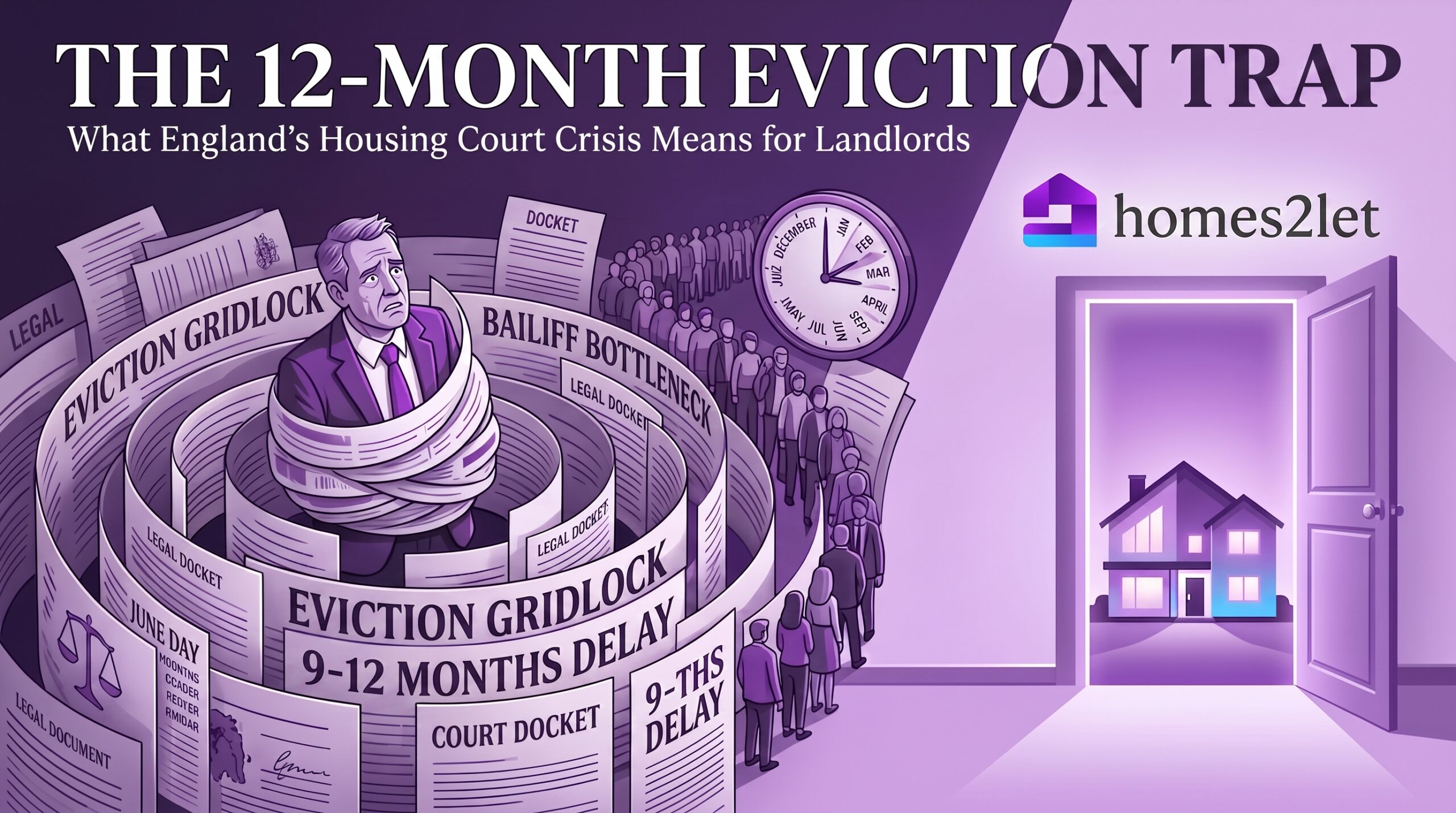
The 12-Month Eviction Trap: What England’s Housing Court Crisis Means for Landlords
You’ve seen the headlines. For months, the property sector has been utterly obsessed with the Renters’ Rights Act and the supposed death of Section 21. But step away from the broadsheet opinion columns and take a look at the grim reality inside your local county court waiting room.
What’s actually happening on the ground is a bureaucratic nightmare. Landlords are finding themselves trapped, watching the legal mechanisms they rely on to regain possession of their own properties completely grind to a halt.
According to a stark new report from The Guardian, England’s housing courts are officially “overloaded.” The bedrock assumption of traditional buy-to-let investing, that if things go south, you can swiftly get your bricks and mortar back, has completely broken down.
So, what do the numbers actually tell us? And more importantly, how on earth do you protect your portfolio from the incoming legal gridlock?
The Reality Check: When a ‘Standard’ Eviction Takes a Year
The core issue isn’t simply that the eviction rules are changing. It’s that the court system doesn’t have the judicial manpower or the capacity to process the sheer volume of cases.
Let’s say you serve a perfectly valid Section 8 notice because you need to sell the property. You might assume you’ll have the keys back in a few months, right? Wrong. The courts are buckling, with some courtrooms frantically trying to cram up to 29 hearings into a single afternoon.
To put the scale of this mess into perspective:
- The Bailiff Bottleneck: Even if you win your case, getting a bailiff to actually enforce the order is another hurdle entirely. In parts of London, the waiting list for a bailiff has stretched to a soul-destroying seven months.
- The Court Delay: Routine housing dispute hearings that used to take eight to twelve weeks to schedule are now dragging on for up to a year.
- The Exodus Effect: Savills estimates that 254,000 buy-to-let homes were listed for sale in the year to March 2026. This year alone, a staggering 110,000 landlords are expected to throw in the towel and exit the market.
- The Local Authority Trap: Local councils are absolutely skint and buckling under emergency housing costs. Their official advice to tenants? “Don’t leave until the bailiffs literally knock on the door.” Tenants are actively being forced to resist amicable departures just to qualify for emergency council support.
It’s a perfect storm, and the remaining landlords are left footing the bill for a fundamentally broken system.
The Landlord’s Paradox: Record Demand vs. Paralysed Courts
On paper, a mass exodus of landlords looks like a golden ticket if you’re staying in the game. A shrinking supply of rental properties means tenant demand is through the roof. It should be an open goal.
The catch? Your legal exposure has never been higher.
When your property is tied up in a 12-month court backlog, every single month of delayed eviction is a direct hit to your pocket. If you’re managing things the old-fashioned DIY way, just one tenant falling into arrears, and subsequently triggering this county court circus, can entirely obliterate your net yield for the year. It’s a gamble, plain and simple.
| Financial Risk Factor | The DIY Landlord Gamble | Homes2Let Guaranteed Rent |
|---|---|---|
| Fixed-Income Arrears | A direct hit to your cash flow the second a tenant’s funds dry up. | 100% Guaranteed rent, paid on the exact same date every month. |
| Tenant Disputes & Arrears | Costly legal fees, court backlogs, and endless, stressful chasing. | Zero hassle – we take on all tenant liaison and legal admin. |
| Unplanned Voids | Zero income while you’re left paying the full mortgage and council tax. | Zero void losses – you get paid 365 days a year, empty or not. |
| Letting Agency Cuts | 10%–15% + VAT shaved off your top line every single month. | 0% Commission with no hidden fees or sneaky renewal charges. |
| Compliance Headaches | Scrambling to keep up with shifting Decent Homes and safety laws. | Complete regulatory shielding and proactive, professional upkeep. |
The Section 8 Shift: Preparing for the ‘New Normal’
With the impending end of Section 21 “no-fault” evictions, the industry is seeing a massive pivot towards Section 8 notices. In theory, this is the government’s grand solution: you can still get your property back if you want to sell up, move in, or if your tenant falls into arrears.
But here is what the headlines aren’t telling you: Section 8 is incredibly admin-heavy. It requires meticulous record-keeping, watertight tenancy agreements, and a burden of proof that simply didn’t exist with a standard Section 21 notice. If a single piece of your initial paperwork is out of date, be it a gas safety certificate or the How to Rent guide, a judge can, and will, throw your case out. That means you go right back to the start of that 12-month queue.
For the everyday landlord, this transition shifts property management from a passive investment into a legal minefield. It’s no longer just about fixing a leaky tap; it’s about maintaining a flawless, audit-ready paper trail for every single tenancy.
Insulating Your Portfolio from Market Volatility
So, how do you insulate yourself from all this noise? You stop gambling.
You shouldn’t have to bet your monthly cash flow on the efficiency of an underfunded county court, or whether a local bailiff has a free slot before next Christmas. With Homes2Let, you eliminate tenant default risk and legal delays in one clean move:
- Guaranteed Rent Every Single Month: You get paid on time, like clockwork. It doesn’t matter if the property has an occupant, sits empty, or is bogged down in a messy legal dispute. Your income is locked in.
- No Sunk Fees: Keep 100% of your agreed rental return without surrendering a hefty slice to high-street letting agents or exorbitant solicitor fees.
- Hands-Off Upkeep: Frantic Sunday morning boiler breakdowns? Not your problem anymore. Our in-house team oversees day-to-day maintenance and Decent Homes compliance.
- Total Peace of Mind: We handle the mountains of paperwork, the statutory safety checks, and the regulatory obligations from day one.
The buy-to-let landscape of the next decade isn’t going to look anything like the last. As legislation tightens and court delays stretch from months into years, trying to run a property portfolio on razor-thin margins without a safety net is little more than financial Russian roulette.
Don’t let a broken legal system dictate your returns. Give the team at Homes2Let a ring today, and let’s talk about how our Guaranteed Rent Scheme can keep your investments secure, no matter what’s happening in the county courts.
To learn more, watch this:

Riz is the founder of homes2let and has been in real estate for over twenty years. He has a background in economics and is a real estate developer and buy to let investor.
You can get in touch with Riz via riz@homes-2let.com.
Related Insights

Government Confirms Major Leasehold Changes on the Horizon
Significant changes to English property law and specifically leasehold legislation are set to be introduced as the Government is poised to radically overhaul the system, making it easier and less costly for landlords and property owners to extend leases or convert them to freehold or commonhold in the future.

In What Circumstances can a Landlord Change the Locks?
When tenants fall into rent arrears or cause damage to a property, it can be tempting for landlords to change the locks to keep them out. However, taking such steps could prove to be a serious mistake, making it all the more difficult to gain the permissions necessary to legally evict a tenant and landing you in trouble with the law. Can a landlord change the locks? Let’s explore the subject in detail.

Understanding Awaab’s Law: A Vital Guide for Landlords
In the wake of the Social Housing Regulation Act 2023, "Awaab’s Law" has fundamentally changed the responsibilities of landlords in England. With strict new statutory timeframes for investigations and repairs, providers must move from a reactive approach to a proactive culture of property management. This article explores the essential legal implications for landlords, the specific deadlines for addressing hazards, and the steps needed to ensure every tenant has a safe, healthy place to call home.