
 020 8444 5555

How to Use Price per Square Foot as a Property Investment Business Model
In the UK, the most common way to describe the size of a house is by number of bedrooms. In the USA and Europe however, the property’s internal area is the measurement of choice. The trouble with number of bedrooms is that it doesn’t really give a clear representation of property size. Here’s why property investment experts are suggesting that price per square foot is the best property investment business model when it comes to determining profitability.

In the UK, the most common way to describe the size of a house is by number of bedrooms. In the USA and Europe however, the property’s internal area is the measurement of choice. The trouble with number of bedrooms is that it doesn’t really give a clear representation of property size. Here’s why property investment experts are suggesting that price per square foot is the best property investment business model when it comes to determining profitability.
Thinking about investment potential in terms of the number of bedrooms a property has can have its downsides. The issue is that a large bedroom could have been divided into two, or a reception room converted into a bedroom. This would increase the number of bedrooms, without affecting the size of the property, and therefore its value. In fact, dividing up rooms to create more bedrooms can sometimes even have the opposite effect on property value.
Better then to consider the property’s internal square footage and its associated value, than number of bedrooms as a property investment model? Experts feel that this is the best way to ascertain the true comparative value of an investment property.
How to measure the internal area of a property?
Whilst there is no generally accepted standard for measuring a property, the overall guideline is to include all the internal spaces, including reception rooms, bedrooms, kitchens, bathrooms and hallways and landings. Advice is to exclude any spaces with a ceiling height of less than 1.5 metres, as well as outbuildings, unheated garages or other outside areas.
If you are studying property particulars, you may wish to take them with a pinch of salt, as ‘optimistic’ measuring methods can overstate figures by as much as 10 per cent.
How to calculate price per square foot?
Once you have your internal area, take the asking or sold price of the property and divide it by the area. For example, a 750 square foot house that sold for £150,000 would have a price per square foot of £200 per square foot.
It is important to consider varying factors, however. Location will be a major driver of price per square foot, with values in London generally outpricing those in other areas of the country. Property quality will also play an important role. Anything that has the potential to push up the value of a property will also impact upon its value per square foot.
How to invest using a price per square foot model?
If you are seeking a property investment opportunity that involves adding value through renovation, you could search for a property with a low price per square foot. This could be a property that is in need of modernisation. By renovating, you will increase the square foot value. Extending the property will usually also add value simply by increasing the square footage.
The price per square foot property investment model can also be used to determine whether it would be profitable to split or merge properties. Comparing local price per square foot rates is a much clearer way to ascertain value and potential than the number of bedrooms model.
Looking to invest in buy-to-let property?
homes2let offers a total property management service with an added benefit. Unlike a traditional property management service, the homes2let guaranteed rent scheme delivers a higher yield, whilst reducing your investment risk by making sure your rent is paid on time every month, even during void periods.
Why not talk to homes2let to learn more? Our helpful team has specific expertise in the South London and Croydon property investment markets, and is ready to share a wealth of knowledge to help you achieve the best possible yield out of your rental income. We welcome you to get in touch today.
Related Insights
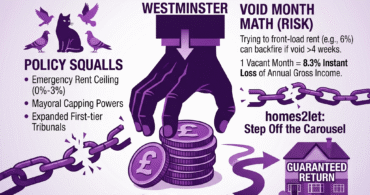
PM Burnham’s Rent Freeze: What It Means for Landlords
If you were hoping the private rented sector might settle into a predictable routine after the Renters’ Rights Act (RRA) overhauled tenancies back on May 1st, I have bad news. Andy Burnham’s arrival at 10 Downing Street has thrown another cat among the pigeons. Fresh off his stint as Mayor of Greater Manchester, Britain’s new […]

Surge in Rent Arrears Sparks Call for Landlords to Protect Their Investments
UK landlords are being prompted to make sure they have appropriate strategies in place to protect their property investments following a recent surge in rent arrear cases. With government data revealing that rent arrears amongst private tenants have increased, and almost two thirds of landlords reporting that they’ve had to absorb arrears-related losses from their savings, it is vital that some form of landlord rent arrears insurance is in place to mitigate future financial issues.

A Breath of Fresh Air for Landlords: The EPC Deadline Delay and What It Means for You
Stop Chasing Moving Targets: Secure Your Rental Income Despite EPC Delays The government has officially pushed back the new EPC assessment methodology until late 2027, giving landlords a vital window of breathing space. With 2.4 million rental properties currently rated ‘D’ or below, the path to the 2030 ‘C’ mandate remains a significant hurdle, but this delay offers a rare opportunity to pause and strategise. While the rules of the game are shifting, your income shouldn't have to. At homes2let, we take the guesswork out of compliance. Our Guaranteed Rent service ensures you receive your payments on time, every month, while we navigate the evolving regulatory landscape on your behalf. Don't let legislative uncertainty disrupt your cash flow—partner with the experts who turn compliance into peace of mind.