
 020 8444 5555

The UK’s Two-Tier Rental Market: Postcode Lottery & Yields in 2026
Think the UK rental property market is cooling down? Look closer at the data. A major geographical postcode lottery is shifting yields away from major urban cities into secondary regional corridors. Here is what landlords need to know.
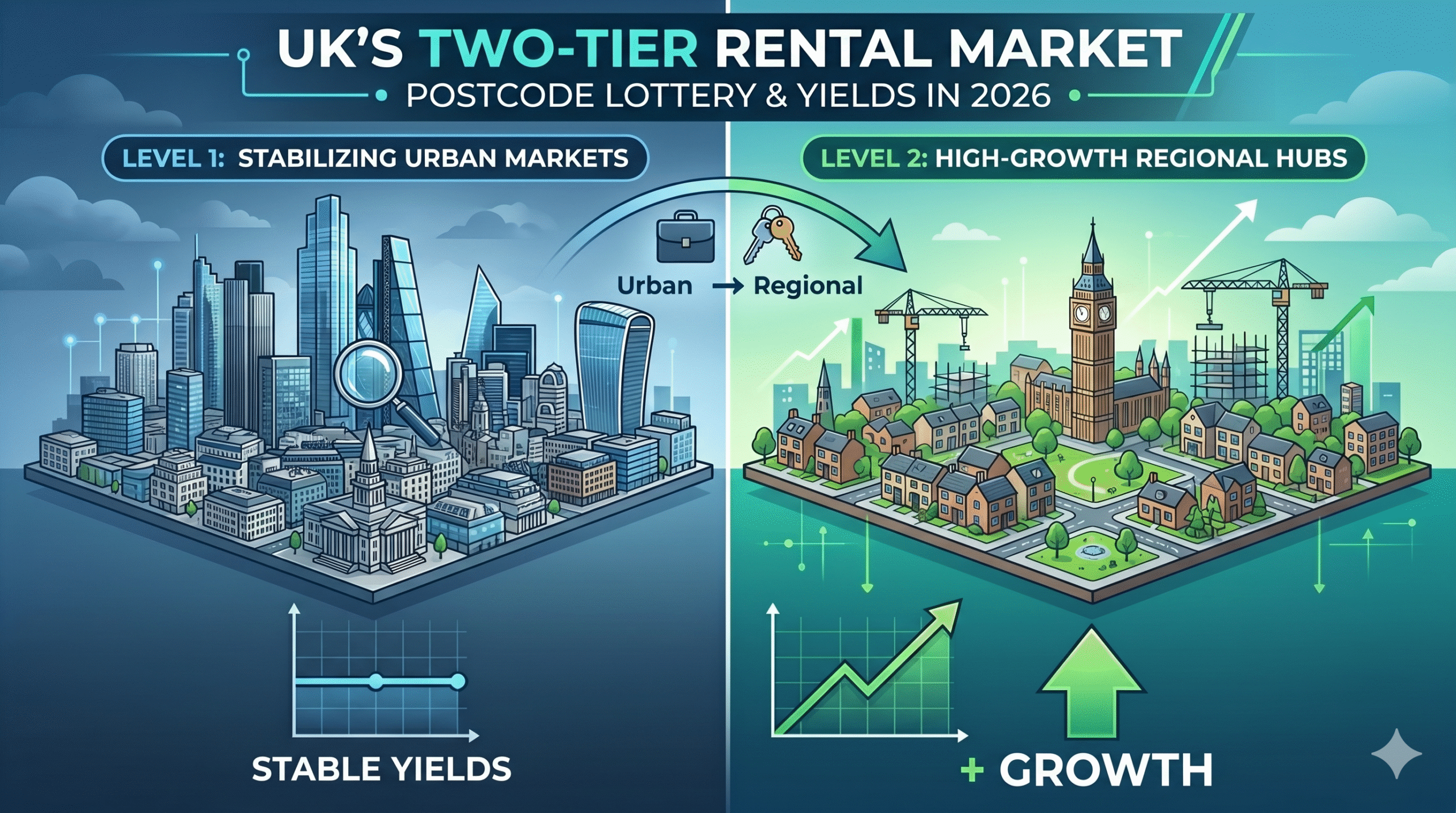
If you’ve been reading the national headlines lately, you’d be forgiven for thinking the UK rental market is finally cooling down across the board. But look a little closer at the data dropped this month, and you’ll find a completely different story. We aren’t looking at a single, uniform market anymore. Instead, the UK has split into two entirely different realities—a classic property postcode lottery.
While rental growth in historically overheated luxury pockets is finally flattening, more affordable regional hubs and outer boroughs are experiencing an unprecedented surge in tenant demand. For landlords trying to maintain profitable yields against a backdrop of high mortgage rates, navigating this geographical split has become the defining challenge of the summer.
Flattening Cities vs. The Regional Rent Boom
The headline revelation from the June 11, 2026 Zoopla Rental Market Report completely shatters the idea of a nationwide slowdown. Yes, national average rental inflation looks modest at 2.1%. But that single figure hides an explosive trend: in areas where average monthly rents sit under £750, prices are rising at nearly 5% year-on-year—more than double the national speed.
While rental growth in major central cities has hit a ceiling—with Birmingham dipping by 1.1% and Nottingham dropping 1.5%—affordable regional hotspots are breaking records. Carlisle is currently leading the UK with a massive 9.1% annual rent increase, followed closely by Kilmarnock at 9.0% and Halifax at 6.5%.
| Urban Centres | Change | Regional Hotspots | Change |
| Birmingham | -1.1% | Halifax | +6.5% |
| Nottingham | -1.5% | Kilmarnock | +9.0% |
| Bournemouth | -1.7% | Carlisle | +9.1% |
What’s driving this extreme localized demand? It’s a massive wave of young professionals and first-time buyers who have been completely priced out of buying a home. The June 5, 2026 Halifax House Price Index confirmed that property prices fell by another 0.1% as mortgage rates remain stubbornly high, largely driven by global economic pressures and inflation expectations. With typical two-year fixed rates hovering around 5.66%, the typical UK home price of £298,806 feels further away than ever for ordinary buyers. This financial climate is trapping premium, high-earning tenants in the private rental sector for much longer, intensely squeezing available rental supply in areas that were historically considered cheaper alternatives.
The Structural Squeeze: Declining Stock vs. Unyielding Demand
To understand why rents are accelerating so fast in these secondary markets, we have to look at the structural supply deficit. Zoopla’s data highlights that competition has actually eased to its lowest level in six years—dropping from a frenzied peak of 15.5 inquiries per listing in 2022 down to a calmer 5.6 inquiries in May 2026. Yet, rents are still heavily insulated from dropping. Why? Because private rental stock is still tracking 20% to 30% below pre-pandemic averages across every single region in the UK. New buy-to-let investments have flatlined due to punitive tax changes and high borrowing costs, meaning there are simply fewer properties to go around. When you couple this nationwide shortage with localized growth, you get a highly volatile market. For example, while southern English regions are lagging—with the South East seeing house prices fall 2.1%—the North West and Yorkshire are experiencing a regional renaissance, with property values rising up to 3.6%. Landlords who treat the UK as a single, uniform market risk making costly investment errors by misjudging local market velocity. The Regional Disconnect: The gap in rents is closing rapidly between affordable regions and major cities. While stretched affordability limits growth in high-cost postcodes, lower-cost areas are seeing sharper proportional increases with far fewer alternatives available to tenants.
The Pricing Trap: Empty Properties vs. Legal Pitfalls
This sharp two-tier split creates a dangerous double-edged sword for self-managing landlords. In slowing urban markets like Birmingham or Nottingham, overpricing a property by even a small margin means it risks sitting vacant for weeks. With average wages growing at 4% and outpacing city rents for 18 consecutive months, tenants are voting with their feet and refusing to pay over-inflated prices. A single void month can completely wipe out a landlord’s annual profit margin. Conversely, in booming high-demand regions, setting the rent too low means missing out on vital yields needed to offset your own rising mortgage and maintenance costs. Worse still, under the newly active rules of the Renters’ Rights Act (which officially came into force on May 1st), rental bidding wars are strictly illegal. Landlords and letting agents are entirely banned from inviting or accepting offers above the advertised price. You can no longer rely on a hot market to push up your rental income naturally via desperate bidders; you must get the advertised price perfectly right from day one. Failing to understand local data can lead to legal penalties or thousands of pounds in lost revenue.
How Does Guaranteed Rent Protect Me in a Two-Tier Market?
In an era where localized market volatility can swing a property investment from profitable to vacant overnight, predictability is everything. This is why a growing number of property investors are moving away from traditional variable lettings in favour of the Homes2Let Guaranteed Rent scheme. When you partner with us, the geographical volatility of the 2026 market stops being your financial problem. We effectively become your corporate tenant, ensuring a fixed, optimized monthly income hits your bank account without fail. Whether your property’s local market is experiencing a temporary cooling trend, dealing with unexpected void periods, or navigating the rigid new anti-bidding legislation, your cash flow remains completely untouched. We handle the local pricing structures, the compliance, and the tenant sourcing, while you enjoy 100% financial certainty.
Related Property News Update
To see a full breakdown of the latest June 2026 data drops and how regional rental shifts are impacting buy-to-let portfolios across the UK, watch the latest analysis from the Property Accelerator channel:
Top 5 FAQs for Landlords Considering Guaranteed Rent Agencies:
1. What is a guaranteed rent agency?
A guaranteed rent agency takes over the comprehensive management of your property and acts as your legal tenant, paying you a fixed monthly income regardless of voids, market dips, or tenant payment issues.
2. How do market fluctuations affect my guaranteed rent?
They don’t. Once your fixed monthly rate is agreed upon with Homes2Let, your income is legally locked in for the duration of the contract. Even if local borough rents drop or a property sits vacant between tenancies, you are paid in full.
3. Are guaranteed rent agencies worth it in a shifting market?
Absolutely. With the 2026 market displaying such hyper-local volatility and bidding wars being outlawed, having a guaranteed financial baseline removes the gamble of property investment.
4. Will a guaranteed rent scheme work for properties outside central urban zones?
Yes. In fact, with regional and suburban areas experiencing the highest proportional tenant demand right now, entering a guaranteed rent scheme is an excellent way to secure high, stable yields in these growth corridors.
5. How does Homes2Let manage property maintenance during the agreement?
We take care of day-to-day internal maintenance and repairs through our dedicated in-house team. We also promise to return the property to you at the end of the agreement in its original condition, subject to fair wear and tear.

Riz is the founder of homes2let and has been in real estate for over twenty years. He has a background in economics and is a real estate developer and buy to let investor.
You can get in touch with Riz via riz@homes-2let.com.
Related Insights

UK Housing Market 2024: Predicted Growth and Key Economic Factors
The UK housing market is set to rebound in 2024, with a projected 5% rise in house prices, buoyed by declining mortgage rates and potential Bank of England interest rate cuts. Improved economic conditions and housing affordability are expected to stimulate market growth, despite previous predictions of a downturn. Stability in the economy, especially in employment, will further support the housing market, maintaining property values and reducing the likelihood of forced sales.

What the Delay to Making Tax Digital Means for Landlords
Originally due to be introduced in April 2023, HMRC Making Tax Digital for Income Tax has now been pushed back to April 2024. What this means for taxpayers and, in particular landlords, is the subject of this latest post.

Breathing Space: Debt Respite Scheme to Prevent Landlords From Chasing Unpaid Rent
From 4th of May 2021, a new government scheme will come into force that will give anyone with a problem debt a legal right to protection from creditors. This includes tenants who are in rent arrears with a debt owed to their landlords. The ‘Breathing Space’ arrangement, otherwise known as the Debt Respite Scheme, will allow debtors time to find a solution to their financial issues.